|
Conduction Cooled PMC (CCPMC) |
Any data acquisition board from General Standards Corporation can be converted to a conduction cooled version.
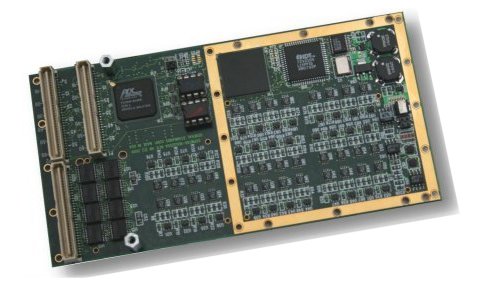
The First Conduction-Cooled PMC card from GSC (CCPMC66-16AI32SSA) is being used in an advanced terrain avoidance system.
This CCPMC analog input card features 32 differential input channels. It has a 16-Bit ADC per channel and
simultaneously samples all channels at rates up to 200,000 samples per second for each channel.
[Read more]
|
|
Data Acquisition |
|
General Standards Corporation is a leading supplier in data acquisition I/O boards, provides a complete family of
data acquisition cards for sonar, industrial, and embedded applications on several form factors/busses, and for many operating systems.
Functions available include analog I/O, serial I/O, and high speed parallel I/O.
|
Form Factors: | |
FREE DRIVERS
AND
LOANER BOARDS |
|
|
|
Software Drivers: |
- Windows
|
- VxWorks
|
- QNX
|
- Linux
|
- MathWorks
|
- Solaris
|
- Labview
|
- xPC Target
|
- Ask About Other Drivers
|
|


- Up to 64 Input Channels per Board
- Programmable Sampling Rates to 50M SPS
- GPS Synchronization
- Auto-Calibration
- Multi-Board Synchronization
- Sigma-Delta and Delta-Sigma Analog I/O
- Resolutions from 12 bits to 24 bits
Analog I/O Selection Tables
- Serial Mode Protocols include Asynchronous, Bisync, SDLC, HDLC, IEEE 802.3, Synchronous Telemetry, Simple Clock/Data ("-SYNC" product line), and Di-phase.
- Transceiver support RS485, RS422, RS232, RS423, V.35, RS530, as well as other software selectable mixed protocol modes
- Up to Eight Independent Serial Channels per Board
- Synchronous Serial Data Rates up to 10 Mbits/sec
- Asynchronous Serial Data Rates up to 1 Mbits/sec
- Deep Transmit and Receive FIFOs up to 128K
- PMC and cPCI rear I/O support
- Custom Protocols Available
Serial I/O Selection Tables
- Cable Transfer speeds up to 400 mb/per second
- Large FPGA provides for flexable cable interface
- Several cable transceiver options including RS-422, RS-485, LVDS, PECL, and TTL
Digital I/O Selection Table
|
|
|
Conduction-Cooled PMC Standard | |
This standard defines the mechanical and thermal interface for a
conduction cooled PCI mezzanine card (CCPMC) to allow for compatibility of
products. Typical usage would be for a CCPMC module to be fitted on top of a
host VMEbus card that conforms to Conduction-Cooled Eurocard standard (IEEE
1101.2-1992, a Standard for Mechanical Core Specifications). However, it is
possible for a CCPMC card to be fitted to any other host card (such as
CompactPCI) as long as that host card presents a mechanical and thermal
interface that conforms to this specification.
This standard is based on the physical (mechanical) layers defined in IEEE
P1386/P1386.1 (CMC/PMC) draft standard, however provision has been made for
increased mechanical support for enhanced shock and vibration performance.
Typical usage would be for a CCPMC module to be fitted on top of a host
VMEbus card that conforms to IEEE 1101.2-1992, Standard for Mechanical Core Specifications
for Conduction-Cooled Eurocards. However, it is possible for a CCPMC card to be fitted to
any other host card as long as that host card presents a mechanical and thermal interface
that conforms to this specification.
The thermal interfaces to the host has been achieved with minimum
restriction to the mezzanine component area by utilizing the front panel and central stiffening bar
areas, normally associated with a conduction cooled assembly. Additional thermal interfaces are
optional for enhanced thermal performance, however these thermal interfaces further reduce
available component area.
The CMC/PMC standard defines a printed circuit board (PCB) profile that
extends beyond the component boundary of the VME base card. Therefore, the PCB length must be
reduced from 149.0 mm to 143.75 mm. The PCB length must be reduced to be compliant with
IEEE 1101.2. The reduction in length does not impact the bezel holes and,
therefore, compatibility with air cooled
assemblies is maintained. Similarly, the I/O connector area of the CCPMC
card faces the base card in an area that has a zero-component-height
limitation. This allows the mezzanine card to accommodate front panel I/O
(as well as increased component heights in the mezzanine I/O connector
area). The front panel I/O connector is not typically used on conduction
cooled assemblies, since the I/O is usually routed to the motherboard J2 (or
P0) via the Pn4 mezzanine card connector.
For more Info on CCPMC specs see:
VITA 20-199x Draft Standard, Conduction Cooled PMC, VITA 20-199x/D1.1011 7
at www.vita.com
|
|